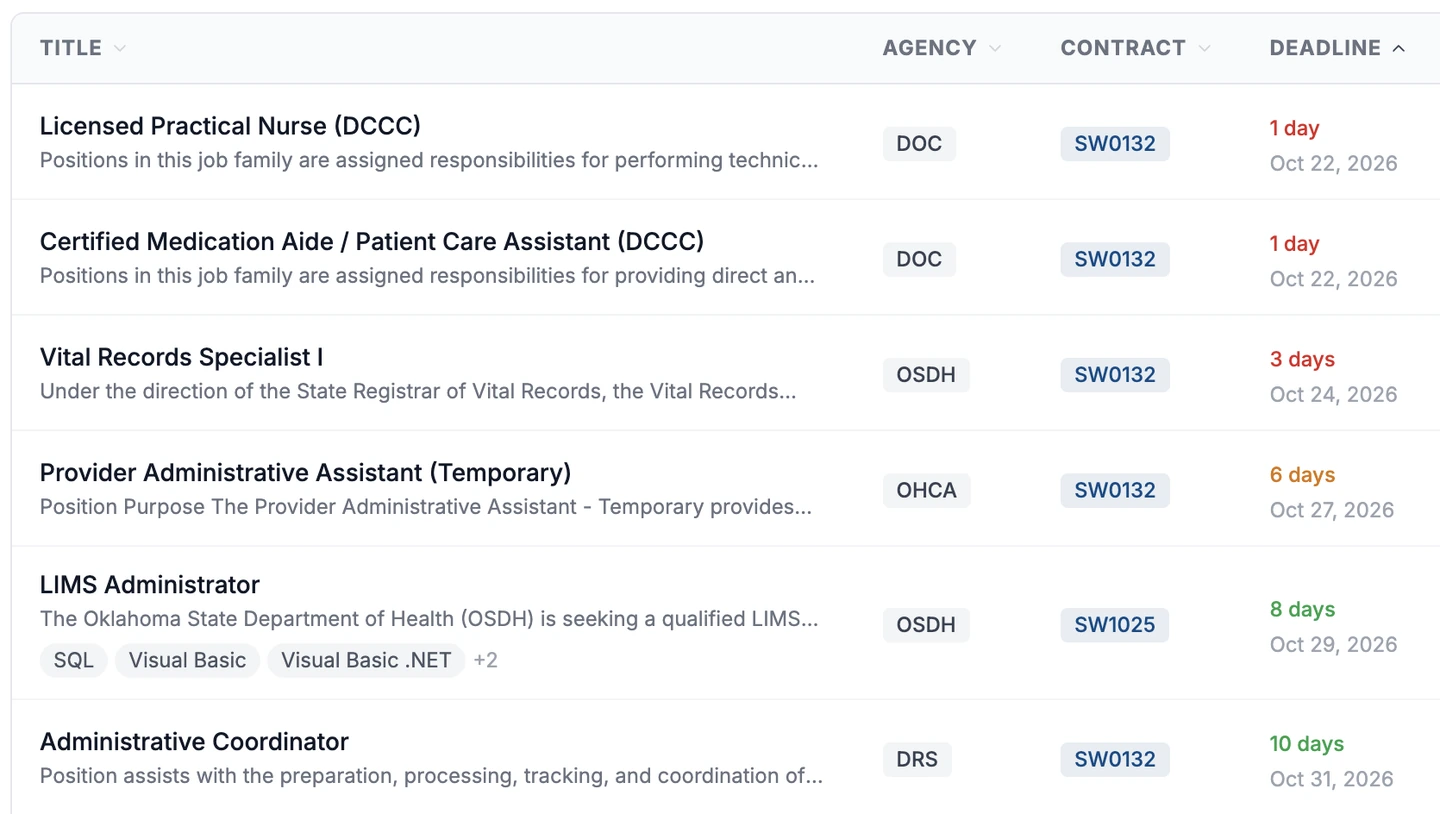
Oklahoma’s Office of Management and Enterprise Services (OMES) recently launched MyOK Staffing and Services, a platform designed to inject more competition into how state agencies hire contractors. Nearly 70 state agencies and 370 suppliers registered on the platform within five months of launch. Concourse delivered the system in less than 12 weeks.
The problem
Last year, Oklahoma state agencies hired dozens of contractors in IT staffing alone. To find each one, state rules required agencies to contact at least three suppliers, which they typically did through a series of emails. “Most of the time, agencies would just go with a supplier that they already knew, because reaching out to other suppliers was very manual and time-consuming,” says Glenda Caudle, IT category manager at OMES. “Agencies were encouraged to develop new supplier relationships to broaden competition and get the best value for taxpayers, but the manual process made that difficult.”
The old process also limited statewide visibility into contractor engagements and renewal timelines. For example, an IT contractor can be hired for one year and renewed twice, after which the agency must accept new bids for that work. Without a shared system, agencies were responsible for tracking those timelines independently, while OMES lacked a centralized view of contracting across the state’s 100-plus agencies.
OMES set out to fix both problems at once: a single place where every opportunity would reach every eligible supplier, and where it could see which contractors agencies were using, at what rates, and for how long.
The solution
The result is the MyOK Staffing and Services portal, which launched in May 2026. Now, when an agency needs a contractor, it can post the opportunity in the portal, which automatically notifies participating suppliers, opening each opportunity to a wider pool of potential bidders.
“Agencies can now actually see the competition that’s out there,” says Caudle. “By centralizing the process, agencies can better evaluate available options, document competition and make informed, value-driven decisions for the state.”
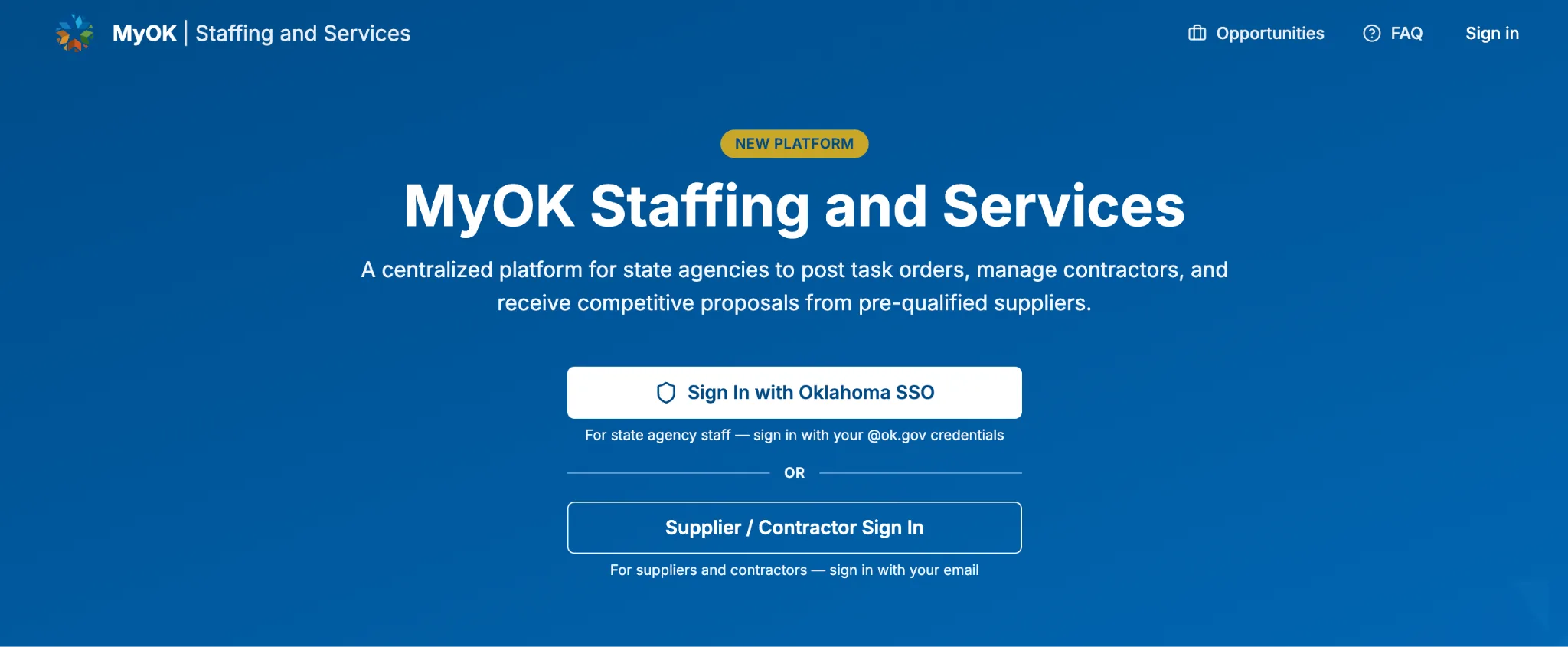
The platform supports five of Oklahoma’s statewide contracts: temporary IT staffing services, deliverables-based IT services, temporary non-IT staffing services, non-IT consulting services, and well-plugging services.
Once an opportunity has been posted, any eligible supplier can submit clarifying questions to the agency through the platform. That supplier gets notified by email when the agency responds, and every eligible supplier can see the Q&A exchange on the platform, giving everyone access to the same information. Agency staff can review submissions, compare qualifications, and select the winning submission—all in the same place.
The portal also gives agencies greater visibility into contract renewal timelines. In the past, an agency had to track those renewals manually. Now, once an engagement reaches the three-year limit, MyOK alerts the agency that the work needs to go back out for bids, helping agencies manage renewals consistently and stay accountable to state rules.
The results
Since the platform launched, the typical posting for IT staffing has received nine candidate submissions. One software application developer posting for the Teachers’ Retirement System of Oklahoma attracted 326 candidate submissions from 132 suppliers, demonstrating the level of marketplace participation agencies can now engage with through the portal.
The platform also makes it easier for agencies to compare competing bids and identify better-priced options. In well plugging, for example, the winning bid has consistently come in below the average competing bid, by between 19% and 54% across seven projects.
OMES has gained greater oversight, too. Officials can now see which suppliers respond to opportunities, monitor contractor engagements and renewals, and ensure that required background checks are completed. “The governance that we didn’t have before is now there,” says Caudle.
“Working with Concourse is like bolting stuff together. It’s just very easy,” says Caudle. “Even when we struggle to communicate what we need from a technology standpoint, they understand. It’s been great.”